
Condo Projects · New Construction
DHHL Could Bring 446 Homes to Kakaʻako Makai
OHA is handing 3.3 acres to DHHL, which could open a path around a 20-year housing ban. Here's what's planned and what's still open.

Quick answer
The Office of Hawaiian Affairs and the Department of Hawaiian Home Lands signed a tentative agreement on October 23, 2026 to move a 3.3-acre lot in Kakaʻako makai to DHHL. Early plans, as reported by Pacific Business News, call for 446 condo units reserved for DHHL beneficiaries. There is no timeline or price yet, and the site's environmental history is still being studied.
Drive down Ala Moana Boulevard toward Kewalo Basin and you'll see two different versions of Kakaʻako. Mauka, it's glass towers, Ward Village and construction cranes. Makai, it's mostly warehouses, open lots and parking.
That split isn't an accident. For about 20 years, a chunk of Kakaʻako makai has been legally off-limits for housing. Now the Office of Hawaiian Affairs and the Department of Hawaiian Home Lands have signed a tentative agreement that could change that for one corner of it.
How OHA Ended Up With Land It Couldn't Build Homes On
Quick bit of history, because it explains why this matters.
In 2006, the state Legislature passed a law banning housing on this stretch of Kakaʻako makai. Then in 2012, OHA accepted land there as a settlement of about $200 million in claims over income from ceded lands. Those are the former crown lands that went to the territorial government, and later the state, after the 1893 overthrow of the Hawaiian Kingdom. Today OHA holds roughly 30 acres in Kakaʻako makai.
So OHA got valuable waterfront land in the middle of Honolulu, with a rule attached that said no homes. Kind of like getting the keys to a car you're not allowed to drive.
The Workaround: Hand the Keys to DHHL
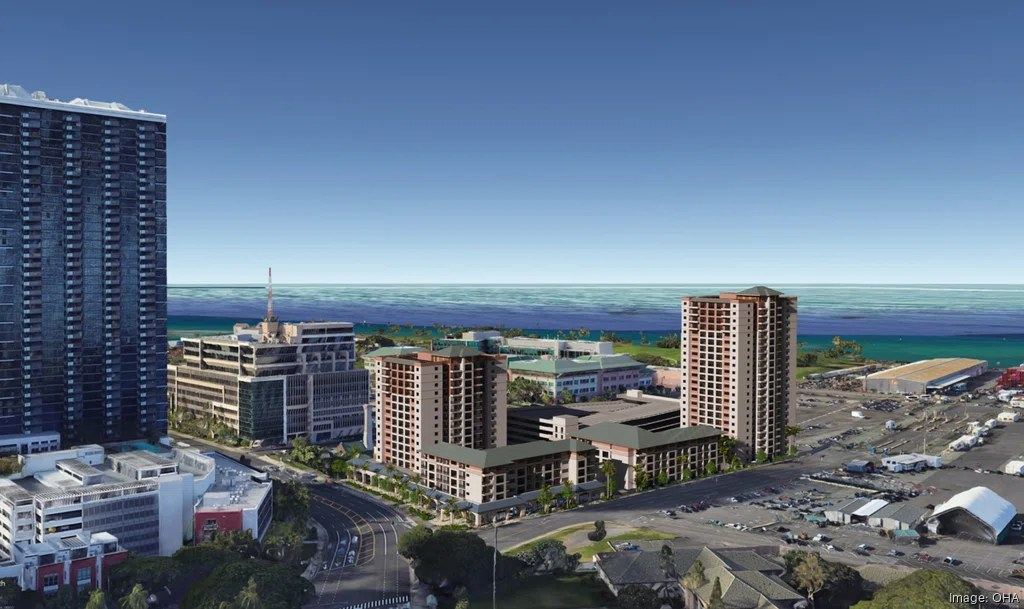
Under the new deal, OHA would transfer 3.3 acres, across Ala Moana Boulevard from The Collection, to DHHL. That's the important part. DHHL is exempt from many land-use regulations, and that exemption is what lets the project move forward where OHA was stuck.
Early renderings from Alakea Design Group show two towers, two smaller townhome buildings and a parking garage. All together, that's 446 residential units, about 13,582 square feet of commercial space and 482 parking stalls. That's enough commercial room for a handful of ground-floor shops or places to grab lunch.
DHHL Is Starting to Build Up
This would be DHHL's second high-rise. The first, Ke Ola Hou in Mōʻiliʻili, was built with Stanford Carr Development and is set to open this month. It has 278 rental units reserved for Native Hawaiian beneficiaries on DHHL's waitlist. We covered it in Where the Bowl-O-Drome Stood, 278 Families Are About to Move In.
That's a real shift for an agency a lot of us connect with homestead lots in places like Waimānalo, Nānākuli and Kapolei. Homes in town put people close to jobs, schools and TheBus, and away from the daily H-1 crawl. For families who've watched cousins and aunties pack up for the mainland (there's a reason Las Vegas gets called the ninth island), more options closer to home count for a lot.
The Kakaʻako plan works a little differently. According to the Star-Advertiser, the units would be condos reserved for sale to DHHL beneficiaries, and OHA would get commercial space in the complex in exchange for the land. But DHHL doesn't sell its land, so buyers would likely own their unit and lease the ground under it, the same basic setup as a homestead lease. That also means these won't be open to the general public the way a typical Kakaʻako condo is. The exact terms haven't been announced yet.
The Landfill Question
Not everyone is ready to celebrate. The project is facing scrutiny over the site's industrial past and its proximity to a former landfill. If you're putting families and keiki on a piece of land, that's a fair thing to ask about.
OHA says it's running detailed environmental testing on all its parcels, paid for with federal money and overseen by the state Department of Health. According to the agency, nothing gets built unless it meets strict health and safety standards. OHA also pointed to other Honolulu projects that went up on former industrial land, like Capitol Place and Iwilei Center.
There's no timeline or price tag yet, either. Right now this is an agreement and a set of renderings, not a groundbreaking.
Why It Matters Beyond Kakaʻako
Four hundred forty-six units won't fix Oʻahu's housing shortage. But in urban Honolulu, where buildable land is scarce and new projects take years, it's a real number. It also shows that land stuck for two decades can move when two agencies serving Native Hawaiians line up behind the same plan.
If it happens, the makai side of Ala Moana could look very different in a few years, with people living there, small businesses on the ground floor and more neighbors walking over to Kakaʻako Waterfront Park for sunset.
For a long time, Kakaʻako makai has been the part of town we drive past on the way somewhere else. This plan still has a long road ahead, but it's a real shot at making it a place people call home.
Sources
- Pacific Business News: DHHL and OHA Kakaʻako makai agreement (October 26, 2026)
- Honolulu Star-Advertiser: DHHL and OHA join forces to unveil Kakaʻako makai housing plan (October 24, 2026)
- Hawaiʻi News Now: OHA, DHHL sign deal to build Kakaʻako makai housing (October 24, 2026)